Hair oil is one of the easiest personal care products to understand and one of the hardest to stand out in. Almost every household in India uses it, and demand is growing in the Middle East, Africa and Southeast Asia. Buyers there trust Indian herbal traditions.
That’s why so many new brands start with hair oil. The product is familiar, customers buy it again and again, and it doesn’t need complicated technology to manufacture.
But “easy to understand” doesn’t mean “easy to get right.” Choose the wrong oil blend, the wrong bottle or the wrong label claim, and your first batch can sit unsold in a warehouse.
This guide explains how working with a private label hair oil manufacturer in India actually works. It covers the decisions you’ll face, the questions to ask, and the mistakes to avoid before you place your first order.
What Is Private Label Hair Oil?
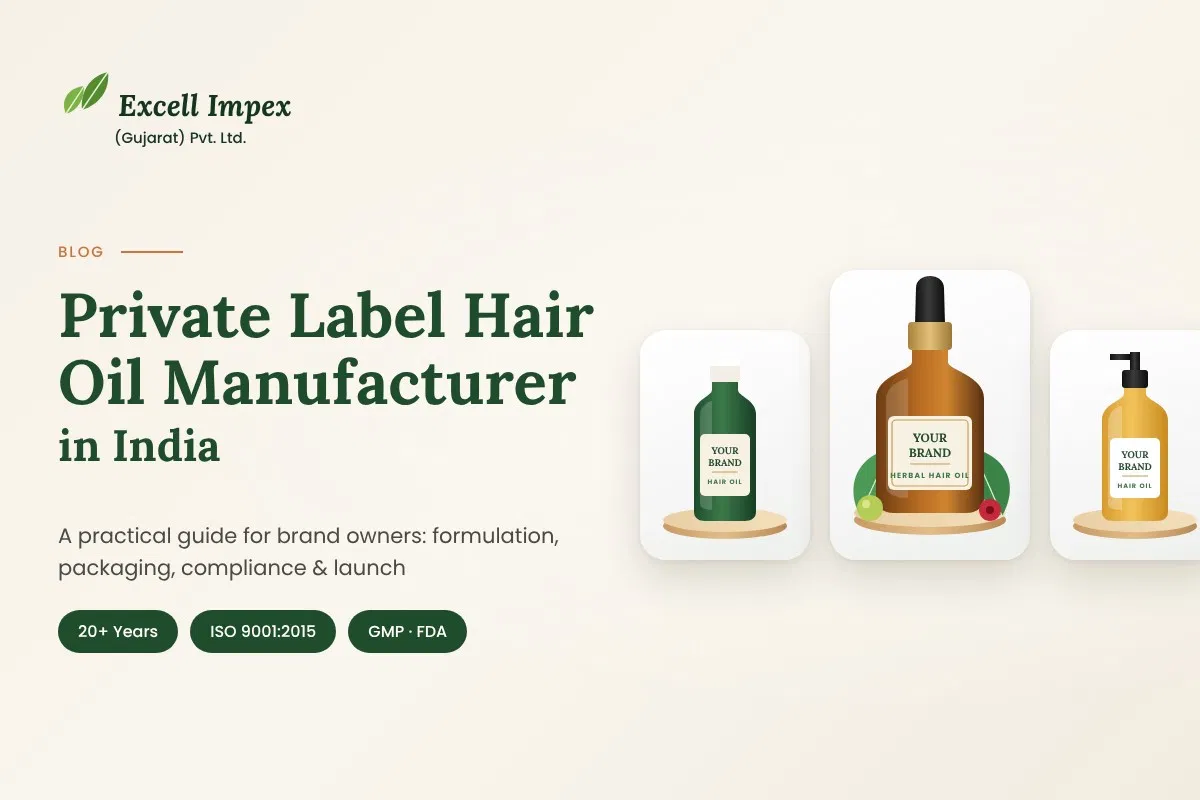
Private label hair oil is hair oil made by a manufacturer and sold under your brand name. You control the brand, the positioning and the sales. The manufacturer handles formulation, production, quality checks and filling.
You’ll also hear the terms third party hair oil manufacturing and hair oil contract manufacturing. In everyday business conversations, they mean much the same thing: someone else makes the product, and your brand goes on the bottle.
In practice, there are two routes:
- Ready formulation: You choose a tested formula from the manufacturer’s existing range and brand it as your own. This is faster and usually cheaper.
- Custom formulation: The manufacturer develops a blend based on your brief, for example a lighter oil for humid climates or a specific mix of herbs. This takes longer but gives you a product competitors can’t easily copy.
Many brands start with a ready formulation, test the market, and then invest in a custom version once sales are proven.
Why Hair Oil Is a Smart First Product for a New Brand
If you’re deciding which product to launch first, hair oil has some clear advantages.
Repeat purchase is built in
Hair oil is used every week, sometimes every day. A customer who likes your oil will usually come back for another bottle within a month or two. That kind of repeat buying is hard to find in many beauty categories.
Customers already understand it
You don’t need to teach people what hair oil does. You only need to explain why your hair oil is better for them. That makes marketing simpler and cheaper.
It works across sales channels
Hair oil sells in local general stores, supermarkets, pharmacies, salons, marketplaces like Amazon and Flipkart, and export markets. One product can support several sales channels at once.
Herbal positioning travels well
Blends with ingredients like amla, bhringraj, hibiscus, neem, fenugreek and coconut have strong recognition among South Asian communities abroad. That recognition is growing with wider audiences too. This makes herbal hair oil a natural fit for export-focused brands.
Key Decisions Before You Contact a Manufacturer
Walking into a manufacturer conversation with clear answers saves weeks of back-and-forth. Here’s what to think through first.
1. Who is your customer?
A hair oil for young professionals in Dubai is very different from one for families in rural markets. Think about age, hair type, climate, price sensitivity and where they shop.
2. What is the main benefit?
Pick one main promise and build around it. Examples include nourishment, scalp care, shine, a non-sticky feel, or a traditional herbal blend. Brands that try to claim everything usually end up remembered for nothing.
3. What should it feel and smell like?
Texture and fragrance decide whether customers buy again. Heavy, sticky oils suit some markets; light, quick-absorbing oils suit others. Fragrance strength matters too. Some buyers want a strong herbal smell, while others want it barely noticeable.
4. What price will you sell at?
Your retail price decides your budget for formulation, bottle quality and packaging. Work backwards from your selling price. Don’t build an expensive product first and then try to fit it into a price point.
5. Where will you sell?
Selling in India, the UAE, Saudi Arabia, Egypt or Singapore can mean different labelling, documentation and registration requirements. Tell your manufacturer your target country on day one.
Choosing the Right Formulation
Your formulation is your product. Here’s what to discuss with your manufacturer.
Base oils. Most hair oils are built on one or more base oils, such as coconut, sesame, almond, castor or mustard. The base decides the texture, how fast the oil absorbs, and the cost.
Herbal extracts. This is where herbal brands set themselves apart. The quality and quantity of the extracts matter, not just the names on the label. If you want to understand why extract quality makes such a difference, read our guide on the power of herbal extracts in hair and skin care products.
Fragrance. Ask whether the fragrance is natural, synthetic or a blend, and whether it suits your target market.
Shelf life and stability. Oils can go rancid if the formulation, raw materials or packaging aren’t right. Ask how stability is checked and what shelf life the manufacturer can support.
Variants. Planning more than one product? A common approach is one “hero” oil plus one or two variants, for example an everyday oil and an intensive scalp-care oil. This keeps your first order manageable.
Packaging: Where Many First Launches Go Wrong
Oil is tricky to package. It leaks, it seeps through weak caps, and it can damage labels. Good packaging decisions protect both your product and your reputation.
Bottle material and size
PET bottles are lightweight and economical. Glass looks premium but is heavier and can break in transit. Decide on sizes based on your channel: smaller bottles suit trial and impulse buying, while larger ones suit regular users and value-focused markets.
Caps and closures
Flip-top caps, screw caps, droppers and pumps all behave differently with oil. Ask your manufacturer which closures they have tested for leakage. Don’t choose on looks alone.
Labels
Oil-resistant label material is essential. A label that smudges or peels after a few weeks on a bathroom shelf makes even a great product look cheap.
Transit protection
If your product is travelling long distances or being exported, outer protection matters as much as the bottle itself. See why double packaging in product manufacturing helps reduce damage and returns.
Claims, Labelling and Compliance
This is the area new brands most often overlook, and it can be costly.
Be careful with product claims
There’s a big difference between “nourishes hair and adds shine” and “cures hair fall” or “regrows hair.” Cosmetic claims describe care and appearance. Claims about treating or curing a condition can move your product into a different regulatory category.
In India, the BIS standard for hair oils, IS 7123:2019, sets requirements for hair oils and similar oil-based hair preparations. It does not cover hair oils that make therapeutic claims. Ayurvedic positioning can bring its own requirements as well. Always confirm with your manufacturer and a regulatory adviser before finalising the wording on your label.
What your label usually needs
Requirements vary by country, but most markets expect details such as:
- Product name and brand
- Ingredients
- Net quantity
- Directions for use
- Batch number and manufacturing or expiry information
- Manufacturer or marketer details
- Warnings, where relevant
Documents to ask for
A reliable manufacturer should be able to provide:
- Certificate of Analysis (COA) for each batch
- MSDS/SDS
- Product specifications
- Certificate of Origin for exports
- Stability information
- Country-specific documents where required
If you’re exporting, check your destination country’s rules before you print packaging in bulk. Reprinting thousands of labels is an expensive lesson.
MOQ, Cost and Timelines
MOQ (Minimum Order Quantity)
MOQ is the smallest number of units a manufacturer will produce per product. It depends on the formulation, the bottle and the label. Stock packaging usually allows lower MOQs than fully custom packaging.
Cost
There’s no single price for private label hair oil. Your cost per unit depends on:
| Cost factor | Why it matters |
|---|---|
| Base oils and extracts | Premium oils and higher extract levels raise costs |
| Fragrance | Natural fragrances usually cost more |
| Bottle and closure | Glass, droppers and pumps cost more than standard PET with a flip-top |
| Label and carton | Custom printing, foil or special finishes add cost |
| Order quantity | Larger runs lower the cost per unit |
| Custom development | New formulas need development and testing |
| Export requirements | Extra documentation, testing or packaging may apply |
The fastest way to get a realistic number is to send the manufacturer a short brief. Include the product, the target market, the bottle size, packaging preferences and the expected quantity.
Timelines
A ready formulation with stock packaging moves much faster than a custom formula with custom bottles. When comparing manufacturers, ask for a stage-by-stage timeline: briefing, samples, approvals, packaging, production, quality checks and dispatch. A quoted “30-day launch” means different things to different suppliers.
10 Questions to Ask a Hair Oil Manufacturer
Use this checklist when speaking to any herbal hair oil manufacturer:
- Have you manufactured hair oil for other private label brands?
- Do you offer ready formulations, custom formulations, or both?
- What is the MOQ per SKU, and does it change with packaging?
- Can I get samples before confirming the order?
- Which certifications does your facility hold?
- What quality checks happen before, during and after production?
- Which closures have you tested for leakage?
- What documents come with each batch?
- Can you support exports to my target country?
- Will you sign an NDA before I share my product idea?
How clearly a manufacturer answers these questions tells you a lot about how they’ll handle your order.
Common Mistakes to Avoid
- Choosing on price alone. The cheapest quote often hides weaker raw materials or poor packaging.
- Skipping samples. Always test the texture, fragrance and absorption yourself, ideally with real customers.
- Launching too many variants. Start focused, learn from sales, then expand.
- Making bold claims without checking. “Stops hair fall” sounds great until a regulator or marketplace questions it.
- Ignoring leak testing. One batch of leaking bottles can damage your reviews permanently.
- Not planning reorders. Ask about lead times for repeat orders so you don’t run out of stock just as demand grows.
How Excell Impex Helps Brands Launch Private Label Hair Oil
Excell Impex is an Ahmedabad-based manufacturer of herbal hair care and personal care products, with more than 20 years of manufacturing experience. Herbal hair oil sits alongside our henna, herbal hair colour, skincare and petroleum jelly ranges, and is one of the categories we offer under private label manufacturing.
Here’s what working with us looks like:
- Ready or custom formulations: Choose from our library of proven formulations, or brief our R&D team on a custom blend.
- NDA before briefing: We sign an NDA before you share your product idea.
- Flexible MOQs: Pilot orders start from around 500 units per SKU, with standard and scale tiers for growing brands. The exact quantity depends on the product and packaging.
- Certified production: We manufacture in an ISO 9001:2015, GMP and FDA certified facility, with quality checks at several stages.
- Documentation included: COA and MSDS come with shipments, plus support with country-specific documents on request.
- Packaging coordination: We help with label artwork, compliance printing and retail-ready packaging.
- Export experience: We supply markets including the UAE, Singapore, Nepal, Iraq and Egypt.
- Faster launches: Suitable projects can move from brief to dispatch in around 30–60 days. Custom work may take longer.
Want to see what a fast launch looks like in practice? Read how a Dubai brand moved through its private label project in our 45-day private label case study. If you’re still at the planning stage for a wider range, our step-by-step guide to launching a private label cosmetics brand in India covers the full process.
Ready to Launch Your Own Hair Oil Brand?
You don’t need a finished plan to start. If you know your target customer, the market you want to sell in, and a rough idea of quantity, that’s enough for a first conversation.
Share your idea with our private label team, and we’ll come back with formulation options, packaging suggestions and a clear timeline. Your NDA is signed before you share a single detail.
Frequently Asked Questions
What is a private label hair oil manufacturer?
A private label hair oil manufacturer produces hair oil that another business sells under its own brand. The manufacturer handles formulation, production, quality control and filling, while the brand owner handles branding, marketing and sales.
What is the MOQ for private label hair oil in India?
It depends on the manufacturer, the formulation and the packaging. At Excell Impex, private label pilot orders start from around 500 units per SKU, with larger tiers available for growing brands.
Can I create my own custom hair oil formula?
Yes. You can brief a manufacturer on the base oils, herbal extracts, texture and fragrance you want. Custom formulas take longer than ready formulations because they need development and testing.
How long does it take to launch a private label hair oil?
A ready formulation with stock packaging can be relatively quick. At Excell Impex, suitable projects take around 30–60 days. Custom formulas and custom packaging usually add extra time.
Can I claim my hair oil stops hair fall?
Be careful. Claims about treating or curing a condition can change how your product is regulated. Stick to cosmetic claims about care and appearance unless you have confirmed the requirements with a regulatory adviser for your market.
Can private label hair oil be exported from India?
Yes. Indian manufacturers regularly supply hair oil to international markets. Each country has its own labelling and documentation rules, so share your destination country with your manufacturer before finalising the formula and packaging.
What documents should I get with my hair oil order?
Typically a Certificate of Analysis, MSDS/SDS, product specifications and, for exports, a Certificate of Origin. You may also need country-specific documents.