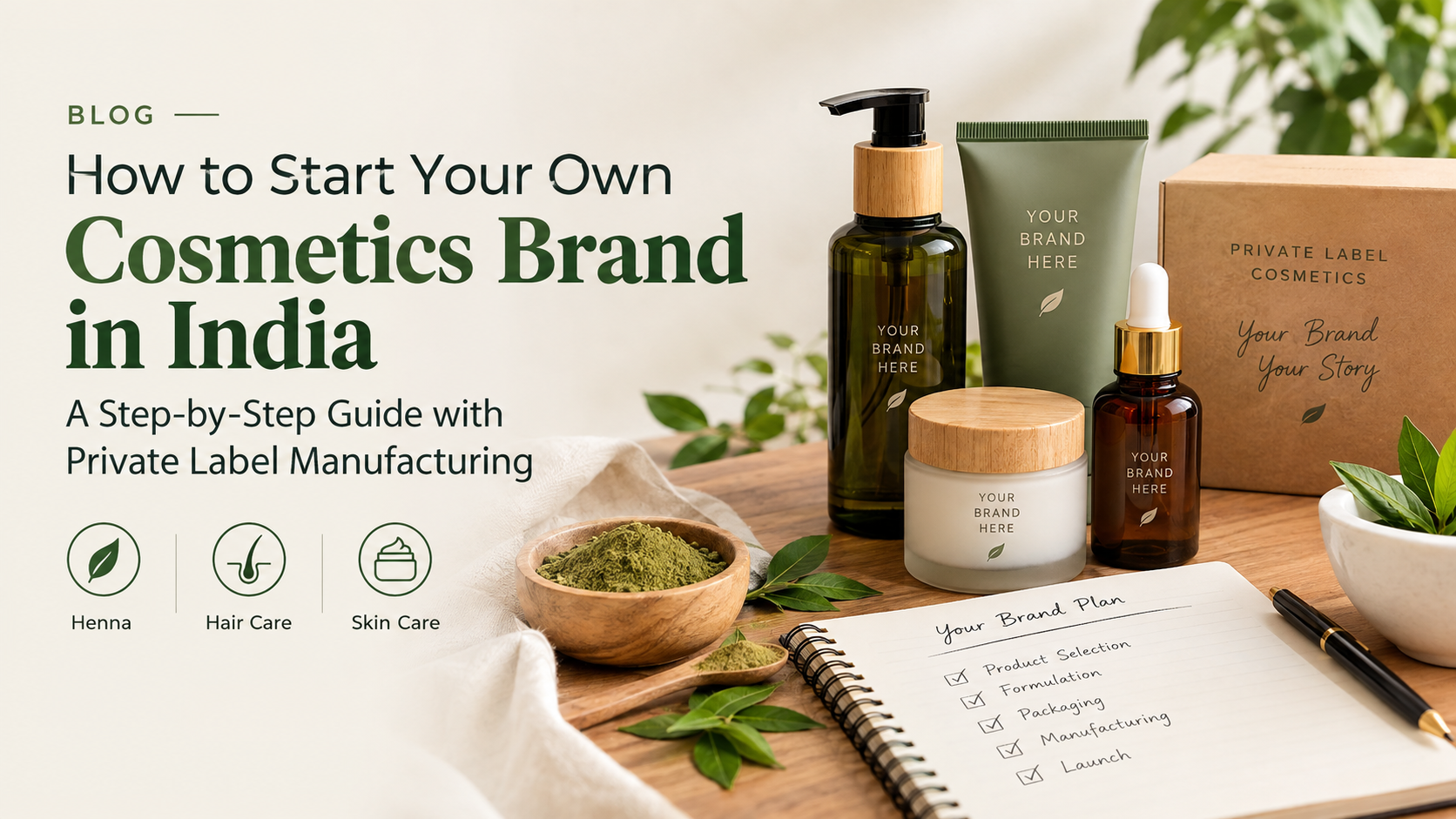
Starting your own cosmetics brand involves more than choosing a product and putting your logo on the packaging. You need to decide what you want to sell, find the right formulation, choose packaging, understand your target market, and make sure the product meets the requirements of the country where you plan to sell it.
This is where private label manufacturing can help. Instead of setting up your own production facility, you can work with an experienced manufacturer to produce cosmetics under your brand name. You can focus on your brand, marketing and customers while the manufacturer handles the manufacturing process.
Private label is commonly used for products such as henna powder, herbal hair colour, hair oil, hair care, petroleum jelly and skincare. You can choose an existing formulation or discuss a product made specifically for your brand, depending on your requirements.
If you’re considering launching your own cosmetics brand, the first step is understanding how the process works and what you should look for in a manufacturer.
What Is Private Label Cosmetics Manufacturing?
Private label manufacturing means selling a product under your own brand that is manufactured by another company.
For example, imagine you want to launch a herbal hair care brand. Instead of setting up your own factory, buying manufacturing equipment and hiring a production team, you can work with a private label manufacturer.
The manufacturer produces the product, and you sell it using your own:
- Brand name
- Logo
- Packaging
- Product positioning
- Marketing
You can choose an existing formulation or, depending on the manufacturer, develop something specifically for your brand.
How to Start a Private Label Cosmetics Brand
There isn’t one fixed way to launch a cosmetics brand, but most projects follow a similar process.
You choose your products, find a manufacturer, agree on the formulation and packaging, complete the necessary checks, and then move into production.
Here is what the process can look like.
1. Decide What You Want to Sell
Before contacting manufacturers, spend some time deciding what your first products will be.
You don’t necessarily need a huge product range. In fact, starting with a few products can make things much easier.
For example, you might start with:
- Herbal henna powder
- Hair colour
- Hair oil
- Shampoo or conditioner
- Face cream
- Body care products
- Other herbal skincare products
Think about who you want to sell to and where you want to sell.
A product aimed at customers in India may have different requirements from one intended for the UAE, UK, EU or USA.
It is also worth considering your expected selling price and how much you are comfortable investing in your first production run.
2. Find the Right Private Label Cosmetics Manufacturer in India
Once you know what you want to sell, the next step is finding a manufacturer that can actually produce it.
Don’t choose a manufacturer based only on price.
Ask questions such as:
- Have you manufactured this type of product before?
- What is your minimum order quantity?
- Can you provide samples?
- Do you offer custom formulations?
- What packaging options are available?
- What quality checks are carried out?
- Which certifications do you have?
- Can you provide the documents required for my target market?
- Do you have experience with exports?
These questions can save you a lot of time later.
If you’re planning to export, mention your target country from the beginning. The manufacturer may need to provide different documentation depending on where your products will be sold.
3. Choose an Existing Formula or Create Your Own
This is one of the first decisions you’ll need to make.
Existing formulation
If you’re happy with a product that is already available from the manufacturer, using an existing formulation can make the process simpler.
It may be a good option if you:
- Want to launch sooner
- Are testing a new product idea
- Don’t need a completely unique formula
- Want to keep initial development costs lower
Excell Impex offers existing formulations for several herbal and personal care products.
Custom formulation
If you have something more specific in mind, you can ask about developing a custom formula.
For example, you may want a particular combination of ingredients, fragrance, texture or product performance.
The manufacturer will normally need information about your requirements before development begins.
Custom products generally take longer because there is more development and testing involved.
4. Protect Your Product Idea With an NDA
If you’re sharing a new formulation, product concept or other confidential information, it’s worth discussing an NDA with your manufacturing partner before sharing sensitive details.
An NDA sets out how confidential information should be handled.
This is particularly important if you have spent time developing a unique product idea and don’t want the details shared outside the project.
At Excell Impex, the private label process can begin with an NDA before detailed product discussions.
5. Discuss Your Requirements With the Manufacturer
Once you’ve chosen a product direction, you’ll need to give the manufacturer a clear idea of what you’re looking for.
You might discuss:
Product: What exactly do you want to manufacture?
Quantity: How many units are you considering for your first order?
Market: Where will the products be sold?
Packaging: Do you want bottles, tubes, jars, pouches or another format?
Branding: Do you already have your logo and packaging artwork?
Formula: Are you using an existing formulation or looking for something custom?
The clearer you are at this stage, the easier it is for the manufacturer to provide an accurate quotation and timeline.
6. Test and Approve Your Product
You should have the opportunity to review the product before committing to full-scale production.
Depending on the project, this may involve samples and discussions around:
- Product texture
- Colour
- Fragrance
- Packaging
- Formula
- Product specifications
- Label design
Take your time here.
Changing a product after thousands of units have been manufactured is much more difficult than making changes during the approval stage.
7. Finalise Your Packaging
Your packaging is more than just the way your product looks on a shelf.
It also needs to provide the information required for the market where you plan to sell.
Depending on the product and destination, this can include information such as:
- Product name
- Ingredients
- Net quantity
- Directions for use
- Warnings
- Batch information
- Manufacturer details
- Shelf-life or relevant date information
You can usually provide your own artwork if you already have a designer. Some manufacturers can also help with packaging design.
If you’re exporting, make sure the label is checked against the requirements of your target market before printing a large quantity.
8. Understand the MOQ Before You Order
MOQ means Minimum Order Quantity.
This is one of the most important questions to ask before choosing a manufacturer because the MOQ can vary considerably between products.
At Excell Impex, private label orders can start from approximately:
-
500 units per SKU
-
2,000 units per SKU
-
10,000+ units per SKU
The exact quantity available to you will depend on the product, formulation and packaging.
If this is your first product, ask whether you can start with a smaller quantity and increase production once you know how the market responds.
9. Make Sure the Quality and Documents Are in Place
Quality control shouldn’t be something you think about after production is finished.
Ask your manufacturer what checks are carried out during manufacturing and what documentation you’ll receive with your order.
Depending on the product, documents may include:
- Certificate of Analysis (COA)
- MSDS/SDS
- Certificate of Origin
- Allergen information
- Stability documentation
- Product specifications
- Relevant quality or manufacturing certificates
If you are selling outside India, there may also be additional requirements for your destination country.
For example, the documentation and registration requirements for selling cosmetics in the GCC can be different from those in the EU or USA.
Your manufacturer should be able to tell you what they can provide and what you may need to arrange separately.
10. Move Into Production
Once everything is approved, the order can move into production.
The timeline depends on what you’re making.
An existing formulation with readily available packaging will generally be simpler than a completely new formula with custom packaging.
At Excell Impex, suitable private label projects can take around 30–60 days, depending on the product, packaging and other requirements.
A typical project may look something like this:
| Stage | What happens |
|---|---|
| Initial discussion | Product, quantity and target market are discussed |
| Product selection | Existing or custom formulation is selected |
| Approval | Product and specifications are confirmed |
| Packaging | Artwork and packaging are finalised |
| Quality & compliance | Required checks and documentation are completed |
| Production | Products are manufactured |
| Final QC | Finished products are checked |
| Dispatch | Products are prepared for delivery or export |
The exact timeline should always be confirmed with your manufacturer before placing an order.
How Much Does It Cost to Start a Private Label Cosmetics Brand in India?
There isn’t a single price for starting a private label cosmetics brand.
Your costs will depend on what you’re making and how you want to launch it.
Some of the main factors are:
- Product type
- Number of products
- Order quantity
- Formulation
- Packaging
- Custom development
- Testing
- Branding and artwork
- Regulatory requirements
- Shipping
For example, launching one product in a simple package is very different from launching five products with custom formulations and premium packaging.
The easiest way to get a realistic figure is to prepare a short product brief and ask the manufacturer for a quotation.
How Long Does It Take to Launch a Private Label Cosmetics Brand?
The answer depends on the product.
If you choose an existing formulation and packaging that is readily available, the process can be relatively quick.
Custom formulation, testing and custom packaging can add more time.
Excell Impex states that suitable private label projects can take approximately 30–60 days, while custom requirements may take longer.
When comparing manufacturers, ask them to break down the timeline. A quoted “30-day launch” can mean something different from one manufacturer to another.
Can You Export Private Label Cosmetics From India?
Yes, Indian manufacturers supply cosmetics and personal care products to international markets.
However, exporting isn’t simply a matter of manufacturing the product and putting it on a plane.
Your destination country may have its own requirements for:
- Ingredients
- Product claims
- Labelling
- Product registration
- Testing
- Safety documentation
- Import documentation
That’s why it’s a good idea to tell your manufacturer where you plan to sell before you finalise the formula and packaging.
Why Work With Excell Impex?
Excell Impex manufactures herbal and personal care products for private label brands, including products in the henna, hair care and skincare categories.
Depending on your requirements, the company can support areas such as:
- Product selection
- Existing formulations
- Custom formulation
- Packaging
- Quality control
- Product documentation
- Export support
The company also offers different MOQ options, including smaller quantities for selected products.
If you already have a product idea, you can discuss your requirements with the team and find out which manufacturing option fits your brand.
Ready to Start Your Cosmetics Brand?
You don’t need to have everything figured out before speaking with a manufacturer.
If you know the type of product you want to launch, your target market and an approximate quantity, that’s a good place to start.
Want to discuss your private label cosmetics idea?
[Request a Private Label Quote →]
Share your product category, expected quantity, target market and packaging requirements with Excell Impex to discuss the next steps.
Frequently Asked Questions
What is a private label cosmetics manufacturer?
A private label cosmetics manufacturer produces cosmetics or personal care products that are sold under another company’s brand. The brand owner manages the branding, marketing and sales while the manufacturer handles production.
How much is the MOQ for private label cosmetics in India?
MOQ depends on the manufacturer and product. Excell Impex offers selected private label products from approximately 500 units per SKU, with larger production quantities available.
How long does private label cosmetics manufacturing take?
It depends on the formulation, packaging, quantity and approvals required. For suitable projects using existing formulations and available packaging, Excell Impex states that production can take around 30–60 days.
Can I request a custom cosmetic formulation?
Yes. Many private label manufacturers offer custom formulation development. You can discuss your desired ingredients, product type, texture, fragrance and other requirements with the manufacturer.
Can I start a private label cosmetics brand with a small order?
Some manufacturers offer smaller MOQ options. Excell Impex offers selected products from approximately 500 units per SKU, although the actual MOQ depends on the product and packaging.
What documents should I ask a cosmetics manufacturer for?
Depending on the product and market, you may need documents such as a Certificate of Analysis, MSDS/SDS, Certificate of Origin, allergen information, stability documentation and relevant quality or regulatory documents.
Can an Indian manufacturer help with cosmetics exports?
Many Indian manufacturers work with international buyers and can provide export-related documentation. However, the requirements depend on the country where you intend to sell, so confirm the specific requirements before production.